Hivetechstack

Author: researchworkrw1990

  • Building the Future: Scalable Blockchain Development for Modern Enterprises

    Enterprise Blockchain Development

    In today’s hyperconnected world, enterprises are rapidly embracing blockchain technology to stay competitive, secure, and efficient. As digital transformation accelerates across industries, Enterprise Blockchain Development has emerged as a critical foundation for building trust, transparency, and automation within business ecosystems.

    Enterprises are no longer simply experimenting with blockchain. Instead, they are actively deploying full-scale blockchain networks that enable real-time data sharing, enhanced security, and streamlined operations. Whether it’s financial services, healthcare, supply chains, or manufacturing, blockchain is driving the next era of enterprise innovation.

    Understanding Enterprise Blockchain: More Than Just Crypto

    Unlike public blockchains such as Bitcoin or Ethereum that are open to everyone, enterprise blockchains are permissioned networks designed specifically for business needs. They prioritize scalability, privacy, and governance—attributes that are vital for corporate adoption.

    Key characteristics include:

    • Permissioned Access: Only authorized participants can join and validate transactions.
    • High Performance: Capable of processing thousands of transactions per second.
    • Data Privacy Controls: Enterprises can control how data is shared internally and externally.
    • Regulatory Compliance: Designed to meet the regulatory frameworks governing industries.

    Enterprise blockchain platforms like Hyperledger Fabric, R3 Corda, and Quorum are leading the charge, each catering to different business models and industry requirements.

    Why Businesses Need Enterprise Blockchain Development Services

    The adoption of blockchain isn’t just about staying trendy—it’s about solving real-world challenges. Here’s why more organizations are seeking Enterprise Blockchain Development Services:

    • Enhanced Data Security: Blockchain’s cryptographic principles reduce the risks of fraud and cyberattacks.
    • Operational Transparency: Distributed ledgers offer real-time visibility into business transactions and processes.
    • Cost Optimization: By eliminating intermediaries and automating processes via smart contracts, businesses can significantly lower operational costs.
    • Improved Traceability: Especially crucial in supply chain management, where provenance tracking is essential.
    • Faster Reconciliation: Transactions validated across distributed networks speed up the reconciliation of accounts and inventories.

    Businesses no longer see blockchain as an experimental technology but rather as a fundamental building block for future-proofing operations.

    Key Use Cases of Enterprise Blockchain Solutions Across Industries

    Blockchain’s versatility is evident across a multitude of industries. Let’s explore how Enterprise Blockchain Solutions are creating real impact:

    IndustryApplication of Blockchain
    Finance and BankingInstant settlements, cross-border payments, KYC compliance
    HealthcareSecure sharing of patient data, clinical trial management
    Supply ChainReal-time tracking, counterfeit prevention
    Real EstateSmart contracts for property transactions
    ManufacturingProvenance tracking, warranty management
    InsuranceAutomated claims processing with reduced fraud risk

    Each of these applications showcases blockchain’s potential to reshape traditional business models through decentralization, automation, and transparency.

    How to Choose the Right Enterprise Blockchain App Development Company

    Selecting a reliable Enterprise Blockchain App Development Company is crucial for successful implementation. Here are some essential factors to consider:

    1. Expertise in Blockchain Frameworks: Ensure the company is proficient with enterprise-grade platforms like Hyperledger, Corda, and Quorum.
    2. Custom Solution Building: Look for firms that tailor blockchain architectures according to your unique business needs.
    3. Proven Track Record: Case studies, testimonials, and industry recognitions are key indicators of expertise.
    4. Consultative Approach: Beyond development, the company should offer strategic consulting to help businesses maximize blockchain’s potential.
    5. Post-Deployment Support: A dependable partner will assist with updates, optimizations, and scaling.

    For example, SoluLab, a trusted Enterprise Blockchain Development Company, specializes in building scalable blockchain applications tailored to specific business models.

    Enterprise Blockchain Development: Strategic Benefits for Enterprises

    Partnering with experts in Enterprise Blockchain Development can unlock a wide range of strategic advantages, including:

    • Increased Business Efficiency: By automating repetitive tasks and streamlining communication between entities.
    • Competitive Differentiation: Companies that integrate blockchain solutions gain a market edge by offering better transparency and reliability.
    • Innovation Enablement: Blockchain opens the door to new business models, such as decentralized finance (DeFi), tokenized assets, and autonomous organizations.
    • Risk Mitigation: Smart contracts and immutable ledgers help minimize human errors and operational risks.

    It’s no longer a matter of “if” enterprises should adopt blockchain, but “how fast” they can leverage its power to stay ahead.

    Future Trends in Enterprise Blockchain Services

    The future of Enterprise Blockchain Services looks even more promising with evolving technologies like:

    • Blockchain and AI Integration: Combining artificial intelligence with blockchain can lead to smarter data analysis, automated decisions, and predictive insights.
    • Decentralized Identity Systems: Enterprises are exploring decentralized identifiers (DIDs) to enhance user privacy and simplify access management.
    • Interoperable Blockchains: Cross-chain technologies are advancing, allowing different blockchain networks to communicate and transact seamlessly.
    • Green Blockchain Solutions: Sustainability-focused blockchains are gaining popularity, addressing energy concerns associated with traditional consensus mechanisms.

    Enterprises must stay proactive, integrating these innovations into their blockchain strategies to maximize long-term value.

    Conclusion: Embracing the Blockchain-Powered Enterprise Future

    Enterprise blockchain technology is no longer a niche—it’s a necessity. As industries demand more trust, transparency, and operational efficiency, the role of blockchain will only become more integral. From enabling secure supply chains to revolutionizing financial services, the potential is limitless.

    Organizations ready to embark on their blockchain journey need a partner with deep technical expertise and industry understanding. Enterprise Blockchain Development Solutions provided by leaders like SoluLab can help turn transformative visions into reality.
  • Generative AI: Transforming Industries with Intelligent Innovation

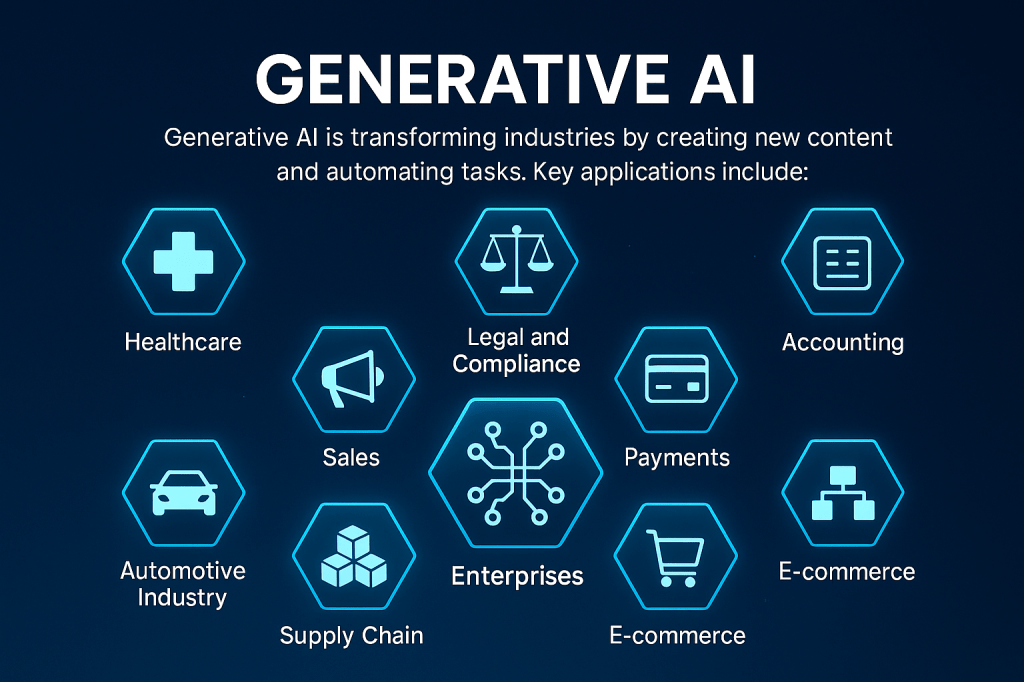
    Generative AI is revolutionizing industries across the board by automating complex processes, enhancing decision-making, and personalizing experiences at an unprecedented scale. Today, businesses from healthcare to automotive are embracing this powerful technology to gain a competitive edge, optimize operations, and deliver more value to customers. Let’s explore in-depth how Generative AI is reshaping key sectors.


    Generative AI for Healthcare

    In healthcare, Generative AI is playing a pivotal role in clinical decision support, personalized treatment planning, and drug discovery. Advanced AI models are trained to simulate patient conditions, predict disease progression, and even suggest tailored therapies.

    • Drug Discovery: Generative models can predict molecular structures, significantly accelerating the discovery phase.
    • Medical Imaging: AI-driven image generation enhances diagnostics by providing clearer, augmented imaging outputs.

    To dive deeper, check this detailed overview: Generative AI in Healthcare.

    Generative AI for Legal and Compliance

    Compliance-heavy industries like legal services are leveraging Generative AI to streamline document review, contract analysis, and regulatory monitoring. AI models can generate case summaries, predict legal outcomes, and identify compliance gaps in real-time, reducing human error and increasing operational efficiency.

    For an in-depth view, visit Generative AI for Compliance.

    Generative AI in Accounting

    Generative AI in Accounting transforms traditional bookkeeping by automating transaction categorization, generating financial reports, and forecasting cash flows. AI models trained on historical data can simulate future financial scenarios, helping firms and enterprises make informed strategic decisions.

    Explore more: Generative AI in Accounting.

    Generative AI in Sales

    Sales teams are deploying Generative AI to create personalized customer pitches, automate follow-up communications, and optimize lead scoring. By analyzing past interactions, AI generates sales strategies that significantly improve conversion rates and customer retention.

    Learn how: Generative AI in Sales.

    Generative AI in Payments

    In the financial sector, Generative AI is redefining payment systems by detecting fraud patterns, generating personalized financial recommendations, and optimizing transaction processing. Intelligent models ensure safer, faster, and more customer-centric payment experiences.

    Understand the full impact here: Generative AI in Payments.

    Generative AI for Enterprises

    Enterprises are increasingly seeking custom Generative AI services to automate operations, personalize customer experiences, and generate new revenue streams. From HR automation to marketing content creation, generative models are embedded across functions to drive productivity and innovation.

    Discover more here: Generative AI for Enterprises.

    Generative AI in Automotive Industry

    The automotive sector is experiencing a major shift with Generative AI applications in design automation, autonomous driving simulations, and predictive maintenance.

    • Vehicle Design: AI models generate innovative vehicle designs that enhance aerodynamics and sustainability.
    • Predictive Maintenance: Simulated failure scenarios help manufacturers preemptively fix issues, reducing downtime.

    Detailed insights here: Generative AI in Automotive Industry.

    Generative AI in Supply Chain

    Supply chains, often burdened by inefficiencies, are being optimized through Generative AI. AI predicts demand patterns, generates optimized inventory models, and simulates supply chain disruptions to build resilience.

    Learn how it’s reshaping logistics: Generative AI in Supply Chain.

    Generative AI in E-commerce

    In e-commerce, Generative AI is utilized for product description generation, personalized product recommendations, and customer service chatbots. Retailers benefit from increased sales, higher engagement rates, and streamlined operations.

    Explore more strategies here: Generative AI in E-commerce.

    Generative AI for Insurance

    Insurance companies are adopting Generative AI to automate claims processing, assess risks, and create personalized insurance plans. By simulating numerous risk scenarios, AI assists insurers in pricing premiums more accurately and efficiently.

    Dive into the innovations: Generative AI for Insurance.


    How Businesses Can Leverage Generative AI

    Organizations aiming to stay ahead in this AI-driven era must engage with experienced generative ai consulting services to ensure successful implementation. Partnering with a trusted generative ai consulting company can unlock transformative growth.

    Choosing the right partner matters:

    • Expertise: Look for generative ai consultants with deep domain knowledge.
    • Customization: Select a team that offers custom generative AI services tailored to your business needs.
    • Credibility: Evaluate generative ai consulting companies based on proven results and client testimonials.

    SoluLab stands out as a top choice in this space. Learn more about their capabilities here: Generative AI Consulting Company.

    If you’re ready to unlock the full potential of Generative AI, partnering with industry experts like SoluLab ensures a seamless journey from ideation to execution. Visit SoluLab to explore how they can help transform your business future.


    Conclusion

    Generative AI is no longer just a futuristic concept – it is a powerful tool redefining the way industries operate. Whether it’s improving healthcare outcomes, revolutionizing automotive design, or enhancing e-commerce experiences, businesses embracing this wave of innovation are positioning themselves for sustainable success. The key lies in choosing the right consulting partner who understands your unique needs and helps you harness the transformative capabilities of Generative AI.

  • How AI Is Transforming Modern Industries: Use Cases from Fintech to Genomics

    Artificial Intelligence (AI) is no longer a buzzword—it is a transformative force redefining how industries operate, make decisions, and deliver value to their customers. From enhancing customer experiences in CRM to accelerating precision medicine in genomics, AI has become a cornerstone of modern business strategy.

    Below, we explore real-world applications of AI across six distinct industries—fintech, genomics, aviation, CRM, KYC, and content creation—and examine how AI development companies are building future-ready solutions.


    AI in Fintech: Driving Smarter Financial Decisions

    Fintech is among the earliest adopters of artificial intelligence, leveraging its capabilities to improve operational efficiency, reduce fraud, and personalize financial services. By analyzing massive datasets in real time, AI enables predictive analytics, risk scoring, and customer behavior modeling.

    A few impactful applications include:

    • Fraud Detection: Machine learning models analyze transaction patterns to detect and prevent suspicious activities in milliseconds.
    • Credit Scoring: AI uses alternative data (e.g., mobile phone usage, social activity) to score unbanked individuals more accurately.
    • Chatbots & Robo-Advisors: Personalized financial advice and 24/7 support are delivered through AI-driven interfaces.

    According to SoluLab’s detailed breakdown on AI in Fintech, the implementation of intelligent systems is reducing loan approval time by up to 80% and operational costs by nearly 30% across digital finance firms.


    AI in Genomics: Accelerating Precision Healthcare

    The role of AI in genomics is groundbreaking. By processing vast amounts of genomic data, AI models help identify gene-disease associations, optimize drug discovery, and tailor personalized treatments.

    Key use cases:

    • Variant Calling: AI detects genetic variants with high accuracy, reducing dependency on manual curation.
    • Drug Target Discovery: Predictive algorithms identify potential therapeutic targets faster than conventional methods.
    • Genomic Pattern Recognition: Machine learning identifies complex patterns and correlations in DNA sequences that humans might miss.

    As noted in SoluLab’s article on AI in Genomics, AI has enabled a 60% reduction in research timeframes for biotech firms developing rare disease treatments.


    AI in the Aviation Industry: Enhancing Efficiency and Safety

    In aviation, artificial intelligence is revolutionizing everything from maintenance operations to flight planning and passenger experience.

    Major applications include:

    • Predictive Maintenance: AI predicts potential equipment failures before they occur, saving millions in repair costs.
    • Smart Scheduling: Algorithms optimize flight schedules and resource allocation in real time.
    • Customer Personalization: AI tailors travel experiences by analyzing individual preferences and behavior.

    SoluLab’s insights on AI in the Aviation Industry reveal that some airlines have reduced maintenance-related flight delays by over 25% through AI-driven diagnostics and automation.


    Integrating AI into CRM: Creating Hyper-Personalized Customer Experiences

    Customer Relationship Management (CRM) platforms are evolving rapidly with the integration of AI. AI transforms CRM systems from static databases into intelligent tools capable of predictive lead scoring, customer segmentation, and behavioral analytics.

    What AI adds to CRM:

    • Sentiment Analysis: Understand customer emotions through NLP to better personalize communication.
    • Lead Prioritization: Rank prospects based on engagement, intent, and readiness to convert.
    • Churn Prediction: Identify customers likely to leave and trigger proactive retention strategies.

    With solutions discussed in Integrating AI into CRM, businesses are seeing a 45% boost in customer satisfaction and significant sales uplift through smarter targeting.


    AI in KYC (Know Your Customer): Making Compliance Smarter and Faster

    KYC is a regulatory requirement that is often costly and time-consuming. AI simplifies and accelerates the KYC process by automating identity verification, monitoring transactions, and flagging anomalies.

    Here’s how AI is reshaping KYC:

    • Facial Recognition: AI verifies identity documents against selfies or live videos in real-time.
    • Document Extraction: OCR and NLP extract data from multiple document formats with high accuracy.
    • Anomaly Detection: Detects irregular behavior in customer transactions to identify potential fraud or compliance violations.

    SoluLab’s post on AI in KYC highlights how AI-based systems have reduced onboarding time by 60% while enhancing compliance accuracy in financial institutions.


    AI for Content Creation: Revolutionizing Marketing and Media

    The creative industry is no longer untouched by AI. From automating blog writing to generating SEO-optimized ad copies, AI in content creation is helping brands produce high-quality content at scale.

    Popular AI content tools empower teams to:

    • Generate Blogs and Captions: Tools like GPT models assist in fast, natural content generation.
    • Enhance SEO: AI helps identify trending keywords and optimize content for search visibility.
    • Automate Visuals: AI creates graphics, video summaries, and dynamic visuals based on input data.

    As covered in SoluLab’s blog on AI for Content Creation, AI solutions have reduced content creation costs by up to 50% and boosted publishing frequency for marketing teams.


    Closing Thoughts: The Cross-Industry Power of AI

    The above examples are just a glimpse into the transformative potential of AI. Whether it’s fraud detection in fintech, genomics-based drug discovery, or automating KYC processes, the possibilities are endless. Companies that proactively invest in AI not only gain operational efficiency but also elevate their value proposition in increasingly digital marketplaces.

    If you’re looking for a trusted artificial intelligence development company, consider choosing an expert partner like SoluLab, a top-rated custom AI development company that provides scalable, enterprise-grade AI development services.

  • Enterprise Ready Blockchain Interoperability: Fueling Scalable Innovation in 2025

    In 2025, enterprises are no longer asking if blockchain fits their operations—they’re asking how to make it work across their diverse, decentralized systems. The ability of different blockchain platforms to connect, communicate, and collaborate is what defines the new era of digital transformation. This capability is called blockchain interoperability, and it is quickly becoming a foundational need for enterprise growth.

    What Does Blockchain Interoperability Mean?

    Blockchain interoperability refers to the capability of independent blockchain ecosystems to share data, exchange assets, and trigger smart contracts across networks. It breaks down operational silos and unlocks the real potential of decentralized systems by fostering a connected digital environment.

    As the market for blockchain interoperability surges, with forecasts pointing toward an exponential rise in value by 2034, enterprises must recognize its impact—not just in theory but in practice. This includes applications in global trade, finance, identity verification, and enterprise automation.

    The Strategic Value of Interoperability in Business

    For organizations operating across jurisdictions, networks, and sectors, blockchain interoperability delivers distinct strategic advantages:

    • Unified Workflows: Enable synchronized data flows and shared logic across business units.
    • Lower Integration Overheads: Reduce development and maintenance costs by enabling plug-and-play compatibility.
    • Real-Time Decision Making: Immediate cross-platform data access enhances operational agility.
    • Customer-Centric Innovation: Supports omnichannel services like unified loyalty programs and cross-chain payments.
    • Technology Agility: Future-proofs systems against changing blockchain standards and market demands.

    Simply put, interoperability isn’t an upgrade—it’s the glue that makes enterprise blockchain sustainable.

    Core Technologies That Power Blockchain Interoperability

    Achieving interoperability between blockchain systems involves several complementary technologies:

    • Cross-Chain Bridges: Facilitate the secure transfer of tokens and metadata between chains.
    • Atomic Swaps: Let users trade digital assets across platforms directly.
    • Protocol-Agnostic Layers: Middleware like Cosmos and Polkadot act as a decentralized communication layer between networks.
    • Inter-Blockchain Communication (IBC): Frameworks enabling standardized data exchange and contract execution.
    • Data Oracles and SDKs: Feed real-world inputs to blockchain applications and connect enterprise software to decentralized ledgers.

    These elements combine to create an ecosystem where applications work together regardless of origin or protocol.

    Leading Frameworks for Blockchain Interoperability

    While no one-size-fits-all solution exists, several proven approaches support interoperability:

    • Validator-Based Consensus Models: Independent parties validate cross-chain transactions without compromising decentralization.
    • Oracle-Powered Event Triggers: Real-world events automatically activate smart contracts across multiple chains.
    • API-Driven Gateways: Serve as enterprise-friendly connectors between internal systems and public/private blockchains.
    • Integrated Multi-Chain SDKs: Provide developers with the tools needed to build cross-chain compatible apps with minimal friction.

    These frameworks offer a reliable and scalable way to bridge previously siloed blockchain ecosystems.

    Enterprise Interoperability and Compliance-Ready Systems

    Enterprises face unique demands—data protection, regulatory compliance, and integration with legacy infrastructure. Interoperability solutions must:

    • Align with international compliance frameworks (e.g., ISO 27001, GDPR).
    • Provide granular permission controls and user access logs.
    • Ensure secure data exchange with on-chain and off-chain systems.

    By meeting these standards, blockchain interoperability becomes a trusted layer in enterprise IT stacks.

    Looking Ahead: The Enterprise Interoperability Landscape in 2025

    Interoperability is no longer a niche innovation—it’s a growth enabler. In 2025 and beyond, expect it to power:

    • Distributed identity systems across borders.
    • Smart city infrastructures with interoperable public and private chains.
    • Cross-chain payments and digital asset management.
    • Collaborative ecosystems that integrate supply chain, fintech, and IoT platforms.

    The enterprises that act now will gain a definitive edge in speed, security, and scalability.

    Explore tailored solutions at SoluLab’s blockchain interoperability page.

    Conclusion: Building the Future with Interoperable Systems

    Enterprises that want to lead in a digital-first economy must think beyond isolated blockchain use cases. Interoperability ensures systems speak the same language creating a unified experience for businesses and users alike.

    SoluLab, a trusted Blockchain Development Company, offers comprehensive Blockchain Development Services and Blockchain App Development Services to help you build scalable, secure, and connected digital infrastructure.

    Let SoluLab help you harness blockchain interoperability and realize the full potential of a decentralized enterprise ecosystem.

  • AI Agents: What Businesses Need to Know in 2025

    As of 2025, AI agents have become a business reality. Tools like Microsoft Copilot and Google’s Duet AI are proving just how effective these autonomous tools can be—delivering up to 70% gains in productivity and saving companies up to $80,000 per month. So what’s powering these outcomes? Let’s explore the AI agents driving real business impact.

    What Are AI Agents?

    AI agents are intelligent software systems that act autonomously, set goals, reason, and take actions based on the environment they observe. From chatbots to autonomous vehicles and smart logistics, these agents are quietly powering some of today’s most efficient systems.

    Their decision-making capabilities stem from their core functions:

    • Reasoning: Evaluating multiple outcomes to determine the best course of action.
    • Learning: Adapting based on feedback and past outcomes.
    • Planning: Sequencing tasks and actions to reach desired results.
    • Autonomy: Operating without constant human input.

    How Do AI Agents Work?

    Unlike traditional AI models, AI agents use external tools and APIs to complete tasks, making them adaptive and context-aware. Here’s how the process unfolds:

    1. Goal Setting: Users define objectives; the agent builds a plan using available tools.
    2. Tool-Based Reasoning: AI agents query databases, trigger APIs, or collaborate with other agents to fill in knowledge gaps.
    3. Iterative Learning: They remember preferences, improve decision quality, and build efficiency with every task.

    Types of AI Agents and Real-Life Use Cases

    1. Simple Reflex Agents
      • Example: Thermostats, motion-based doors.
    2. Model-Based Agents
      • Example: Self-driving cars, smart vacuums with memory mapping.
    3. Goal-Based Agents
      • Example: Warehouse robotics, navigation apps.
    4. Utility-Based Agents
      • Example: Investment advisors, autonomous driving systems.
    5. Learning Agents
      • Example: Chatbots, recommendation engines, AI tutors.
    6. Hierarchical Agents
      • Example: Manufacturing systems, smart city infrastructure.

    Pros and Cons of AI Agents

    Benefits:

    • Automates repetitive tasks
    • Reduces operational costs
    • Enhances accuracy and speed
    • Learns and adapts from feedback

    Challenges:

    • High computational demands
    • Multi-agent dependency risks
    • Data privacy considerations

    Real Case Study: SoluLab’s AI in Retail

    One of the most impactful implementations of AI agents comes from SoluLab, a top AI Agent development company. They recently developed an intelligent assistant for a leading retail chain that automated inventory management, optimized demand forecasting, and reduced waste by 32% in three months.

    This AI Agent was integrated with point-of-sale data, supplier APIs, and real-time weather forecasts to dynamically predict demand. Over time, it even learned to adjust for holiday surges and localized trends resulting in smarter restocking and improved profit margins.

    This case illustrates how AI Agent development Solutions can deliver tangible, measurable outcomes in real-world settings.

    Why You Need an AI Agent Development Company

    Implementing AI agents is complex. It involves system design, data integration, performance optimization, and long-term monitoring. That’s where working with a proven AI Agent development company like SoluLab makes all the difference.

    SoluLab offers:

    • End-to-end AI Agent development services tailored to business needs
    • Secure architecture, scalability, and user-centered design
    • Consulting for integrating AI agents within existing workflows

    Whether you’re in logistics, healthcare, retail, or finance, they bring tested ai agent solutions that adapt to your operational needs.

    Final Thoughts

    AI agents are not future tech they’re today’s performance drivers. If you’re still evaluating where to begin, start with a free consultation from the top ai agent development company and take a confident step toward automation that actually works.

  • How AI is Quietly Rewriting the Rules of Business

    While much of the AI conversation is filled with speculation, several industries are quietly integrating it in practical ways that are improving operations and outcomes.

    Let’s take banking. AI-driven risk models are replacing traditional credit scoring, offering more nuanced assessments based on real-time financial behavior. As an ai development company, SoluLab has supported banks in building intelligent systems that can reduce loan default rates significantly.

    Finance leaders are using AI to detect fraud and offer smarter financial planning. SoluLab developed an AI-based investment advisor that helps users manage portfolios based on real-time market fluctuations.

    In education, AI helps instructors identify struggling students early. One school district, with SoluLab’s support, created an AI dashboard that tracks student engagement and recommends tailored interventions.

    The healthcare industry has seen substantial AI-driven innovation. From AI-based triage tools to patient monitoring systems, real-world applications are delivering faster, more accurate outcomes.

    Even in tourism, AI is enhancing planning tools, making it easier for travelers to get personalized itineraries and real-time travel updates.

    Meanwhile, manufacturers are adopting AI for inventory forecasting and robotic process automation.

    As a leading provider of ai development services, SoluLab is enabling these shifts by delivering practical, tested AI Development solutions to forward-looking companies.

  • Future-Proofing Healthcare with Artificial Intelligence What You Need to Know

    Ai in HealthCare

    As the healthcare industry continues to digitize, Artificial Intelligence is playing an increasingly central role in shaping its future. By combining computing power with medical insight, AI is streamlining clinical processes, enhancing patient engagement, and enabling precision-based treatment at scale.

    Enhancing Clinical Intelligence
    From identifying anomalies in MRIs to recommending drug therapies, AI models assist clinicians in making more accurate and faster decisions. These tools not only boost diagnostic accuracy but also minimize time to treatment vital in critical care settings.

    Reducing Burnout, Increasing Efficiency
    AI automates administrative functions like billing, appointment management, and inventory planning. This operational efficiency reduces staff burnout and allows healthcare professionals to focus more on patient care.

    Sustainable, Inclusive, Intelligent
    As we navigate toward AI-driven ecosystems, inclusivity and security must remain priorities. Ethical AI development, robust compliance measures, and collaborative ecosystems will ensure AI’s positive impact is universal.

    SoluLab is more than just an AI Development agency we’re a strategic technology partner. Our award-winning AI development services have transformed businesses by integrating intelligent systems across diagnostics, patient management, and administrative workflows. Our Medicgraph success story stands as a testament to our capabilities as a top-tier AI development company.

    Visit us to learn more or connect with our experts.

  • Strategic Advantage Starts Here: Partnering with the Right Gen AI Consultants

    Every ambitious business is asking the same question in 2025: how can we leverage generative AI? The answer lies in smart execution, and that begins with the right generative AI consulting services. A successful implementation can boost efficiency, increase revenue, and create competitive advantage.

    But navigating this terrain isn’t easy. You need a seasoned generative AI consulting company that understands both the technical landscape and your business ecosystem. That’s exactly what SoluLab offers. As one of the most trusted generative AI consulting companies, we deliver real-world AI solutions grounded in measurable success.

    Our approach is collaborative. Our generative ai consultants partner with your internal teams to align AI strategy with business goals, design user-friendly workflows, and implement responsibly. We don’t sell hype—we deliver results.

    Discover the difference with SoluLab—explore our offerings here and connect now to take the first step towards transformation.

  • Tokenized Diamonds in 2025: Turning Timeless Luxury into Liquid Digital Assets

    Imagine owning a share of a million-dollar diamond—without ever stepping foot in a vault. Sounds like something out of a tech thriller, right? In 2025, it’s not fiction—it’s the new frontier of investing.

    Diamonds have long been coveted as luxury assets. Yet for decades, they remained one of the most illiquid and inaccessible investments, locked behind opaque pricing and centralized markets. Now, thanks to blockchain, they’re entering the digital age.

    According to current projections, the global diamond market is growing steadily—set to rise from $105.2 billion in 2024 to $140.1 billion by 2032. Natural diamonds account for $86.86 billion, with synthetic diamonds at $53.24 billion. The rise of real world asset tokenization services is helping shift this age-old market toward transparency, accessibility, and scale.

    What Is Diamond Tokenization?

    Diamond asset tokenization is the process of turning physical, certified diamonds into blockchain-based tokens. Each token is backed by a real, authenticated gem stored securely in a third-party vault. Through this, investors can own fractions of high-value diamonds, just like buying shares in a company.

    This is more than just digitizing an asset—it’s reimagining ownership, liquidity, and access.

    Why 2025 Is the Year of Tokenized Luxury

    Here’s what makes diamond tokens a game-changer:

    • Secure & Tamper-Proof: Ownership is logged on a blockchain, preventing fraud and double-spending.
    • Fractional Ownership: Instead of buying an entire diamond, investors can hold small, affordable stakes.
    • Certified & Vaulted: All tokens represent real diamonds, verified by GIA/IGI and stored in insured facilities.
    • Smart Contract Automation: Transfers, payments, and royalty mechanisms are built into the code.
    • Ease of Trading: These tokens can be listed on marketplaces and traded globally—24/7.

    The best part? With help from an experienced asset tokenization development company, launching a platform to facilitate this is now faster and more secure than ever before.

    How the Tokenization Process Works

    Whether you’re a business, investor, or collector, here’s how the tokenization journey typically looks:

    1. Choose & Certify the Diamond
      It starts with selecting a verified diamond. Agencies like GIA or IGI authenticate its attributes—cut, clarity, carat, and color.
    2. Vault Storage
      The diamond is then placed in a secure, insured vault by a third-party custodian.
    3. Create Metadata
      Digital profiles are created with certificates, images, IDs, and traceability data.
    4. Develop Smart Contracts
      These contracts encode ownership rules, trading permissions, and even profit-sharing if applicable.
    5. Mint the Token
      Depending on the platform, it could be an NFT (non-fungible) for individual diamonds or a fungible token representing a pool.
    6. Marketplace Listing
      Tokens are listed on trading platforms or DeFi apps for purchase, sale, or collateral use.
    7. Regular Audits
      Compliance is critical. Trusted platforms carry out regular audits and integrate KYC/AML checks to maintain credibility.

    Use Cases: More Than Just Investment

    Diamond tokenization goes beyond investment portfolios. Here’s where these tokens shine:

    • Luxury Retail Authentication: Sell a diamond ring with a digital token for authenticity and traceability.
    • Collateral in DeFi: Lock diamond tokens in DeFi protocols to borrow against their value.
    • Global Transfers: Move diamond ownership between countries without customs or shipping logistics.
    • Supply Chain Verification: Verify ethical sourcing and trace each touchpoint using blockchain.
    • NFT & Digital Collectibles: Showcase rare diamonds in luxury NFT vaults, with tie-ins to AR and digital art.

    What’s Fueling This Trend in 2025?

    The reasons are clear:

    • Market Volatility is pushing investors toward stable, alternative assets like luxury collectibles.
    • Blockchain Adoption is mainstream—used in everything from banking to fashion.
    • Lower Entry Barriers mean everyday investors can now access what was once elite-only.
    • Smart Ownership lets users control and track their investments with full transparency.

    SoluLab’s Leadership in Diamond Tokenization

    As a forward-thinking asset tokenization development company, SoluLab has built a reputation for turning physical assets into fully digital, investable opportunities.

    Our latest contribution, launched on Token World, is a shining example of innovation. We delivered full-stack asset tokenization development services—from backend vault integrations to frontend token trading dashboards.

    With SoluLab, clients can tokenize anything from rare diamonds to entire vaults of luxury goods. We streamline compliance, develop secure smart contracts, and design investor-ready platforms tailored to your vision.

    Final Word

    Tokenized diamonds are leading a luxury investment revolution—and it’s only just begun. By blending the physical rarity of diamonds with blockchain’s transparency, we’re entering a new era of ownership.

    Looking to explore this opportunity? Talk to SoluLab—one of the most trusted asset tokenization companies worldwide—and bring your tokenization vision to life.

  • How AI Content Creation is Changing the Game for Marketers

    Content marketing has long been the fuel for growth, brand storytelling, and customer engagement. But in 2025, the game has fundamentally changed. The shift? Artificial Intelligence. No longer a buzzword, AI has become the strategic co-pilot for content teams aiming to scale faster, smarter, and more effectively.

    With the global AI-powered content creation market projected to grow from $2.9 billion in 2024 to $3.53 billion by 2025, smart brands are seizing the opportunity to evolve—not just to produce more, but to produce better.

    Why AI in Content Creation is More Than Just Automation

    AI for content creation combines advanced algorithms with machine learning to automate and augment the creative process. This means everything from generating ideas and writing copy to editing visuals and analyzing audience engagement can now be optimized.

    Let’s unpack the key advantages:

    • Enhanced ROI: With AI development services, brands gain insights into what content formats and channels yield the highest engagement.
    • Market Intelligence: Real-time competitor and trend analysis ensures your strategy is proactive, not reactive.
    • Speed + Scale: Use AI tools to schedule, optimize, and distribute content at a fraction of the time.
    • Creative Support: From writing blog outlines to designing ad creatives, AI assists in keeping your strategy fresh and agile.

    Where Can You Use AI in Your Content Workflow?

    1. Blog and Social Media Writing
    AI platforms like ChatGPT or Jasper can generate headlines, meta descriptions, and social posts tailored to your brand voice.

    2. Scriptwriting for Podcasts & Videos
    Cut down hours of scripting time with AI that suggests dialogue based on popular narrative formats and audience data.

    3. Localization & Translation
    Bridge language barriers with tools like DeepL or Google Translate, powered by neural networks that ensure context-sensitive translations.

    4. Visual Content Creation
    Create infographics, banners, and ad creatives using Canva’s AI designer or Adobe Firefly, even if you have no prior design skills.

    5. Video & Audio Production
    Use tools like Pictory and Lumen5 to repurpose articles into video. With Descript, you can generate voiceovers and edit podcasts in minutes.

    6. Content Research & Ideation
    AI-based engines like HubSpot’s generator or AnswerThePublic scan keywords and deliver actionable content ideas instantly.

    Benefits That Matter for Marketers

    • Faster Turnaround: Reduce content cycles from weeks to hours.
    • Lower Production Cost: Replace repetitive manual work with automated workflows.
    • Scalable Execution: Maintain quality across larger content volumes.
    • Insight-Driven Improvements: Know what works, when, and why.
    • Competitive Advantage: Stay one step ahead by adapting to trends in real time.
    • Creative Collaboration: Use AI as a teammate to unlock more innovative storytelling.

    Human Touch Still Matters

    It’s important to remember: AI isn’t replacing creativity—it’s enhancing it. Today’s tools aren’t just generating content; they’re helping us learn faster, ask better questions, and solve bigger problems.

    By leveraging models built on spaced repetition and Socratic questioning, AI encourages deeper content planning, audience understanding, and creative development.

    Tools Worth Exploring in 2025

    • ChatGPT – An all-rounder AI content assistant for writing, ideation, and planning
    • Claude – Ideal for strategic thinking, long-form writing, and nuanced messaging
    • Lumen5 – For video creation straight from text
    • Canva AI – For professional visual design made easy
    • Pictory – For turning blog posts into scroll-stopping video

    SoluLab’s Role in AI-Powered Content Success

    SoluLab, a trusted Artificial Intelligence development company, recently partnered with AI-Build to create intelligent, scalable workflows in the construction tech industry. Using custom AI Development solutions, we streamlined their CAD product design processes, saving time and unlocking new value streams.

    Whether you’re in marketing, engineering, or media—our AI development services empower your teams with automation that supports creativity, not replaces it.

    Want to Reimagine Your Content Strategy?

    AI is changing the rules of content creation. It’s time to embrace smarter workflows and bolder strategies. If you’re ready to amplify your brand’s voice and results, hire a generative AI developer at SoluLab or connect with our experts.

    Let’s co-create the future—faster, together.

Design a site like this with WordPress.com
Get started